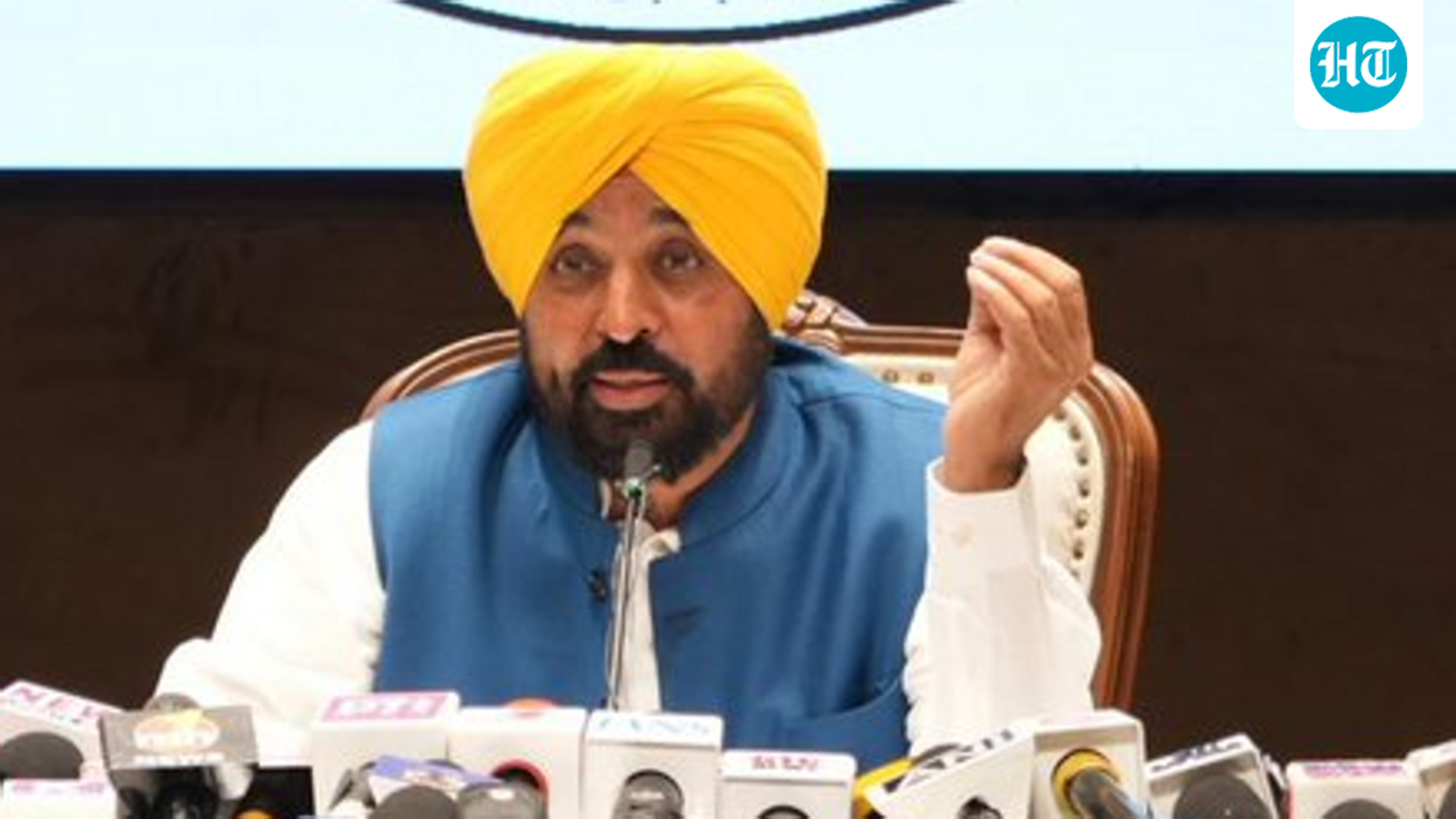

Punjab chief minister Bhagwant Mann. (X)
At the core of the proposed meeting, however, lies a demand that sits uneasily within India’s constitutional framework: the “recall” of seven Rajya Sabha MPs who recently switched sides. The demand, though politically resonant, runs up against a clear constitutional limitation since there is no provision in India that permits the recall of a member of Parliament (MP).
Once elected, a Rajya Sabha MP holds office for a fixed term of six years under Article 83, having been elected by state legislators under Article 80. That tenure cannot be prematurely curtailed except through resignation, disqualification, or other narrowly defined constitutional routes. The idea that an MP can be “recalled” by political displeasure, or even by a change in the party’s fortunes, finds no place in the constitutional text.
This makes Mann’s outreach to the President more of a political intervention than a legal one. The Constitution does not vest the President with any authority to terminate or review the membership of MPs on such grounds. Questions of disqualification fall squarely within the domain of the presiding officer of the House — in this case, the Rajya Sabha chairman, subject to judicial review. Even where the President does play a role in questions of disqualification under Articles 102 and 103, it is exercised on the binding advice of the Election Commission of India (ECI) and within a tightly circumscribed legal framework.
Article 102 lays down the grounds on which an MP can be disqualified, such as holding an office of profit, being of unsound mind, being an undischarged insolvent, not being a citizen of India, or incurring disqualification under any law made by Parliament (including laws like the Representation of the People Act). Article 103, in turn, prescribes the procedure to decide such questions. If any doubt arises as to whether an MP has incurred a disqualification under Article 102, the matter is referred to the President, who is constitutionally bound to obtain the opinion of the ECI and decide the issue in accordance with that opinion. In effect, the President does not exercise an independent adjudicatory discretion but acts on the ECI’s binding advice in a quasi-judicial process. A demand for “recall” falls outside this scheme entirely.
The real legal contest, if any, lies elsewhere — within the anti-defection law contained in the Tenth Schedule. The seven MPs, led by Raghav Chadha, have invoked the “merger” exception, which protects legislators from disqualification if at least two-thirds of a legislature party agrees to merge with another party. That claim has already been accepted by the Rajya Sabha chairman, but it remains open to challenge.
As recent constitutional jurisprudence, particularly the Supreme Court’s ruling in Subhash Desai Vs Principal Secretary, Governor of Maharashtra (2023), has emphasised, a legislature party cannot act independently of the political party itself, raising serious questions about whether numerical strength alone can validate a merger. These are issues that may ultimately require judicial determination, not executive intervention.
The political irony of the present situation is difficult to miss. Only months before leading the defection, Chadha argued in Parliament for a statutory “right to recall”, contending that voters should not be bound by underperforming representatives for an entire term. He had also sought to tighten the anti-defection law by raising the merger threshold from two-thirds to three-fourths. This, curiously, is a change that, had it been enacted, might have prevented the very defection he later spearheaded. Neither proposal was adopted, leaving the current framework intact and permissive enough to enable the shift.
Comparative constitutional practice offers little support for Mann’s demand. While recall mechanisms exist in some jurisdictions, including Taiwan, Peru, Venezuela, and Ecuador, they are explicitly codified and largely confined to local or sub-national offices. Parliamentary systems like India have consciously avoided such provisions, favouring stability of tenure over mid-term political reversals. The absence of a recall mechanism reflects a deliberate constitutional choice, not an oversight.
In that light, Mann’s proposed meeting with the President appears less an attempt to invoke a viable constitutional remedy and more an effort to frame the defections as a betrayal of public mandate, particularly in Punjab, where the political impact is most acute since the state goes to the polls next year. By taking assembly members along to Rashtrapati Bhavan, even if symbolically, the chief minister is signalling collective political grievance rather than pursuing a legally sustainable course.
The episode, eventually, highlights a deeper tension within India’s constitutional design. While the anti-defection law seeks to curb opportunistic political shifts, it does so within a framework that still allows significant manoeuvring through the merger exception. At the same time, the Constitution offers no direct mechanism for voters or parties to reclaim a mandate once representatives have been elected. Until that balance is revisited through legislative or constitutional change, demands such as “recall” could remain powerful political rhetoric but constitutionally hollow.