
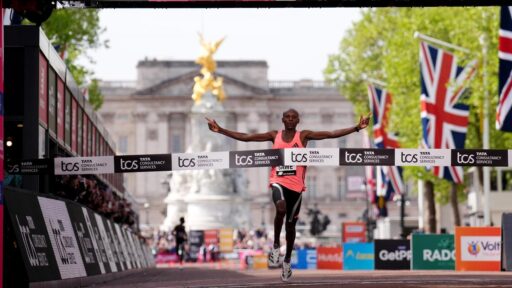
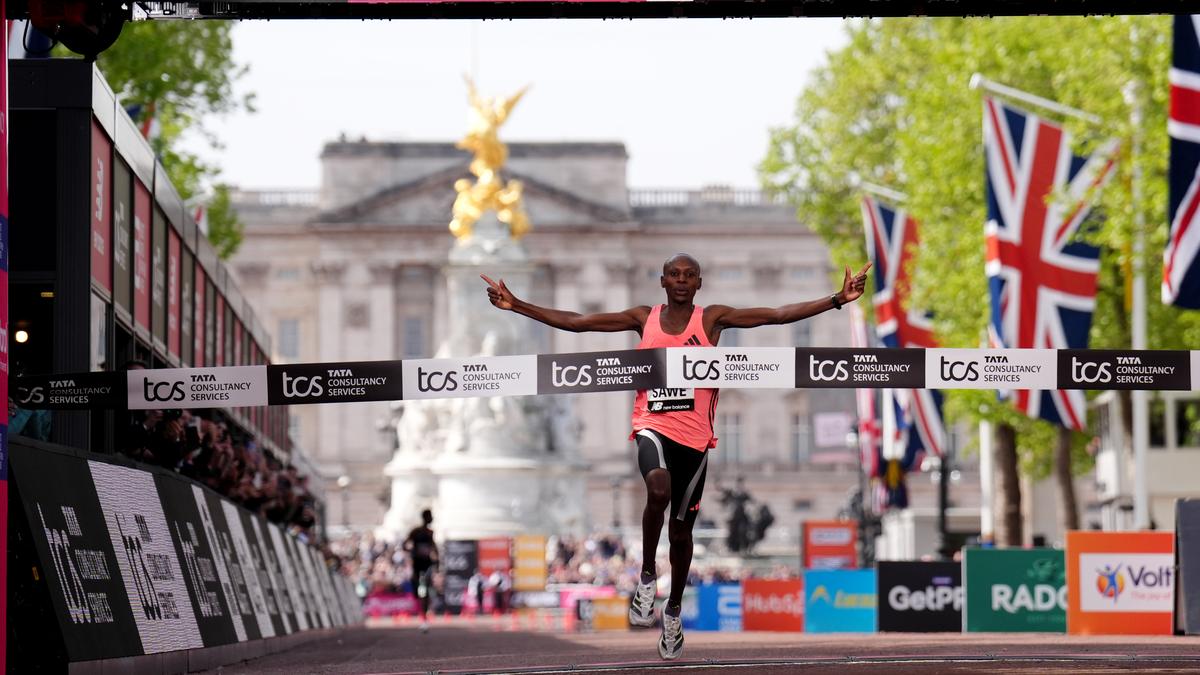

The 31-year-old Kenyan, who on Sunday became the first man to take less than two hours to run a marathon in race conditions, is assured of immortality. His feat is a first-ballot candidate for any sporting hall of fame; his breakfast has a strong case for entering the culinary wing.
Cultural significance
Sawe’s shattering of the long-unapproachable two-hour barrier in London ranks alongside Roger Bannister’s first sub-four-minute mile at Oxford in 1954 in terms of cultural significance. Both achievements have expanded the perception of what was thought humanly possible. For context, the first sub-2:30 marathon came in 1925 and the 2:15 barrier was broken 38 years after that; at the turn of the century, the world’s best time was 2:05:42, set in 1999.
Sawe’s time of 1hr 59min 30 sec was an astonishing 65 seconds inside the previous best of 2:00:35 set in Chicago in 2023 by Kelvin Kiptum, whose death in a car crash in 2024 plunged Kenya into mourning. Two years later, Sawe gave his country reason to rejoice.
Incredibly, 11 seconds after the unthinkable happened, it happened again. The marathon had its second sub-two runner. Ethiopia’s Yomif Kejelcha, 28, finished second in 1:59:41 on his marathon debut. (Kenyan great Eliud Kipchoge did run a marathon in under two hours in 2019, but his 1:59.40 did not make the record books, as it was a specially tailored event in favourable conditions, not a competitive race.)
Sawe’s statistics were dizzying. He completed the London Marathon — on a relatively flat course on a mostly sunny day (15 degrees Celsius), ideal for running — with a negative split. The second half of his race was faster than the first. With the assistance of pacemakers in the initial kilometres, he did the first half in 60:29 and then sped up, clocking a remarkable 59:01 for the second. He averaged 21.2 km per hour, or 2 minutes 49.9 seconds per kilometre.
“I have shown that nothing is not possible,” said Sawe. “I had courage to push even when the pace was so fast. I was not bothered because I was ready for it.”
Running 42.195 kilometres — a distance that has been around since ancient times — in less than 120 minutes was once treated as a natural physiological ceiling. A marathon tests a human being’s energy supply (accessing and burning ‘fuel’ without dropping pace), aerobic limit (maximal oxygen uptake), and biomechanical precision (running form and cadence).
So how did Sawe ace this test? The Kenyan, born in the Rift Valley Province to a father who worked as a maize farmer and raised by his grandmother in a mud-walled house, is extraordinarily talented and trains with punishing intensity.
“Definitely physiologically, Sabastian has to be a good one,” said Claudio Berardelli, the Italian coach who recognised Sawe’s potential and has since guided him on the path to greatness. “But all the pieces come together perfectly because of his attitude, because of his character. In 22 years I’ve been coaching in Kenya I thought I’d seen pretty much everything, but then Sabastian started to show me something which I thought was almost impossible.”
Elevated at altitude
Sawe’s high-volume training at altitude in Kapsabet, Nandi County, with a strong group of athletes who push him, has contributed significantly to his progress. In London, Berardelli said his athlete had been even fitter than in Berlin in September when the late-summer heat had spoiled his previous assault on the world record.
“In the last six weeks he was averaging 200km and above a week, while the peak was 241km,” said Berardelli. “I knew he was super-good for Berlin, but he couldn’t express himself because of the conditions. But when I started to see him running the way he ran before London, I was like, hey, something special might come out.”
While a large part of Sawe’s success is a consequence of his talent and its careful nurturing, there is no doubt that he has benefited from the developments in nutrition and — to a greater degree — the technological arms race launched by shoe companies a decade ago, when they began using carbon-fibre plates and other materials to make shoes lighter and springier.
“We are in the new era of marathon running because of the shoe and proper fuelling,” Berardelli said. According to the BBC, Sawe reportedly worked with a research team from a sports nutrition brand which specialises in hydrogels. He trained to absorb 90-120 grams of carbohydrates per hour during the race without feeling distress. This tops the glycogen levels up, allowing the body to use carbohydrates, rather than slower-burning fat reserves, as fuel.
Cutting edge: The newly developed Adidas shoes Sawe wore to navigate the streets of London were the lightest in history, the first ‘super shoe’ to weigh under 100g. | Photo Credit: Getty Images
The newly developed Adidas shoes Sawe wore to navigate the streets of London were the lightest in history, the first ‘super shoe’ to weigh under 100g. They clearly made a difference — second-placed Kejelcha was wearing them too.
The combination of thick foam in the sole, shaped with a ‘drop’ from heel to forefoot to keep runners ‘forward’ in their stride cycle, and stiff carbon in the midsoles, which store and return energy, reportedly acts as a lever and spring system.
The result is better running economy — in ‘super shoes’, athletes burn less energy at a given pace than in regular running shoes. There has been criticism of ‘super shoes’, the argument being that using them is akin to mechanical doping. World Athletics has tried to regulate the revolution, but there is no doubt that it has played a major role in the lowering of times.
Sawe’s achievement will inevitably be viewed against the backdrop of an appalling series of doping cases among Kenyan athletes in the last few years. But, in a bid to allay such suspicions about his own performances, he has voluntarily subjected himself to extra drug testing. Adidas provided $50,000 to the Athletics Integrity Unit to frequently test Sawe over a 12-month period.
That began with a reported 25 out-of-competition tests in the lead-up to Berlin in September, continuing at a similar rate as he prepared for London.
Next up: Mission 1:59?
The obvious question is whether Sawe can run even faster. Berardelli believes that his athlete could breach 1:59 on a quicker course such as Berlin or Chicago. “Sabastian hasn’t reached his maximum potential. It was only his fourth marathon, if we think of long-term adaptations, which is a process requiring time, I believe Sabastian has not reached this yet,” said Berardelli.
“When I started dealing with Sabastian, I immediately realised this is not just one of the best Kenyan guys. At least for my experiences, he is a different human being. An outlier.”