
For an entire generation, it was the day Indian cricket discovered what was possible. For those that followed, it became the moment that changed everything. At the centre of that transformation stood Kapil Dev, the man who altered the trajectory of Indian cricket forever.
That version of him has become part of India’s sporting consciousness, preserved in memory and immortalised in countless highlight reels. The man, however, has long since moved on.
Retirement opened the door to a different passion. Golf, a sport he discovered after cricket, gradually became a defining part of his life. What began as a post-retirement curiosity evolved into a passion, and eventually a mission. Today, as president of the DP World Professional Golf Tour of India, Kapil finds himself championing a sport he only discovered after hanging up his cricket boots, investing in its future with the same enthusiasm that once powered India’s charge on cricket fields around the world.
The setting for this conversation could scarcely be further removed from the frenzy that once surrounded him.
Tucked away well outside the hustle and bustle of New Delhi city is Kapil’s farmhouse, where there are barely any indications that it’s the residence of one of India’s most celebrated athletes. There are no ostentatious reminders of sporting greatness, no shrine to a glittering career. Instead, the property breathes a different kind of richness.
Vegetable patches stretch across the grounds. Open spaces invite silence rather than spectacle. More than 40 rescue dogs, cared for by his wife Romi, roam the expansive compound. It is here, amid the stillness, that The Hindu sat down with the 67-year-old to discuss what he calls, somewhat surprisingly, the finest phase of his life. Excerpts:
Talk to us about your interest in golf. How did that happen?
This has been a beautiful journey. Basically, when I stopped playing cricket, I wondered what to do next. Either you go to television and start talking about cricket or do coaching, most probably. But I wanted to stay away from people, because you’re with them for almost 15-20 years. You now want to just chill and relax.
A friend of mine introduced me to golf and I loved it. Why? Only one reason. I’m not depending on somebody. I played sports where I depended on others (before) but this gave me a thrill.
I’m not saying cricket didn’t give me that, it gave me more than anything I could ever imagine in several lives. But this gave me a special kick.
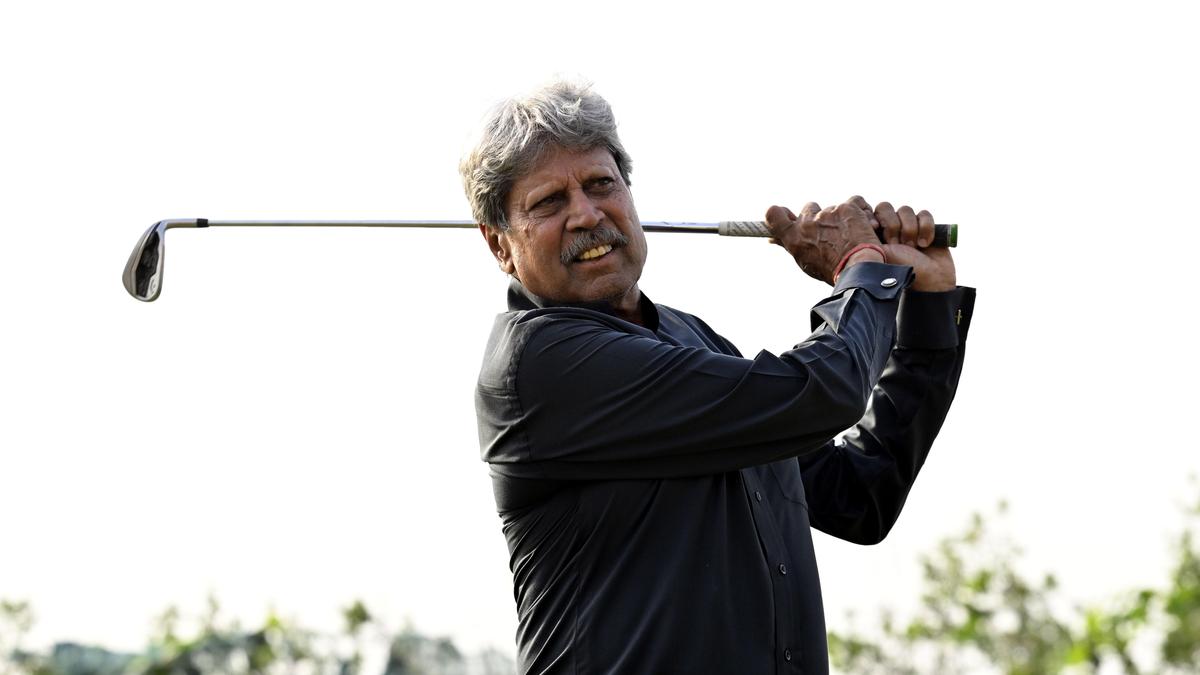
Kapil Dev. | Photo Credit: SHIV KUMAR PUSHPAKAR
How did it go from a hobby to serving as the president of PGTI today?
When you meet golfers here, you come to know how much hard work they put in and the reward they get is not up to that standard, even though they work even harder than cricketers. I felt that we can help them have a better life with the sport
Why should they not get a chance to become better athletes and also earn a livelihood? That’s what changed my thought process and I told myself that I should do something for golf.
Had I not (started) played the game, I wouldn’t have done anything, to be honest.
And any sport in India, not just golf, the moment people start following it, their bar for it is cricket, where India is a dominant force. So when somebody like Aditi Ashok plays in the Olympics, or Jeev Milkha Singh and Shubhankar Sharma take part in other international events, the expectations inherently comes with an unfair expectation of medals and titles…
It’s not right to compare. Cricket has its own place, as does golf and football and every other sport. Yes everybody talks about cricket in India and that’s because the administration has done well to take it up to that level. At this stage, golf in India needs infrastructure, the most important thing for any sport.
Look at cricket today, we’re talking about being the best in the world because our infrastructure is better than any other country’s. Hats off to the cricket board, they’re giving young players all the facilities they require.
Take any sport, or even beyond. Our country has produced so many software engineers, because we’ve given them the right platform. That’s why today we’re talking about Indians being some of the best in that field.
And how is PGTI working on extending those opportunities beyond your big cities?
We don’t have many golf courses in smaller cities. They’re coming up only now. In the last 10 years, we have organised tournaments in various ‘smaller’ cities, like the one in Raipur.
If you give people a chance, maybe golf will also have someone like (MS) Dhoni come from Jharkhand or elsewhere. We need to give those opportunities, for which we require a lot more golf courses. If we have that, we will produce a world champion. As administrators, it is our job to give those opportunities, not only boys but girls also. Take Aditi, she has done impressively globally and now people understand that Indians are very close to winning the medals that nobody thought we could.
Is there a push from PGTI to ensure that this kind of interest is taken up at the school level?
That’s very tough. Yes, it will be nice, but every school can’t have a driving range, even the bare minimum required for kids to start hitting the ball. Schools in smaller cities can do it a lot more easily than those in big cities like Delhi, Mumbai, Kolkata, Bengaluru and Chennai, because the land is not so freely accessible. But we want to walk, slowly, before we run. We want to make sure every year we take the sport to different parts of the country to not only expand its footprint but also increase the interest.
Kapil Dev at his home in Noida. | Photo Credit: SHIV KUMAR PUSHPAKAR
Is live telecast, on TV or online, something you are focusing on?
We cannot compare any sport with cricket, they’re doing it for the last 50 years. Besides cricket, no game is really televised that much in India. Yes, we’re working very hard with our commentators to help people look at golf as the beautiful game that it is.
When a big event, like the Olympics, comes around, fans are focused on the sports where they think a medal is a possibility. This makes golf an afterthought. How do you, who has been one of the greatest athletes the country has produced, think we can get over this mindset?
Yes, you would like to see your country win medals but people should go and admire the sport for what they are. We should admire and support our own people.
In our country, people are still not eagerly making a profession out of sports. They’re not making a life out of that. In cricket, they are. Today people come to me and say that they want to play in the IPL. I feel very sorry. I want them to say that they want to play for India. But I can understand as they see how they’re going to make their life through the IPL. But my aim is always higher. You should look to make a name for your country.
On that note, PGTI has done well to increase the prize money pool every year. How easy or difficult has that been? And what is your aim going forward?
It was not hard. I just talked to my friends and tried to convince them. Lots and lots of friends of mine have come forward to try and promote the game. I can only say we shouldn’t expect the government to solely do everything for us, for any sport.
We can take help from the corporate world, they have the money to put in sports. Not only golf but anything. It’s our responsibility to tap that avenue and make the game bigger. We’re ready to take CSR (Corporate Social Responsibility) money also.
If there is no money, people will let it go. The young kids will have a passion up to one level. When we start making life through sports the game will change in our country, the way cricket has.
The league system is one obvious way to take a sport forward in India and golf has two of them. Despite being rivals, you welcomed it wholeheartedly.
IPL has given a lot of sports thought process. We should have a league where we can make a life for the players. And, 72 The League is a way for us to look after our people. You can’t look after all the 400-500 people but if you look after the top 50-100 people, it will trickle down. This league gives opportunities for players to show their talent and play like a team. Golf is very individualistic but we wanted to give them the taste of teamwork also.
And coming to the two leagues being there, We want to have four or five leagues, as long as every league has its own agenda. We are very happy as long as they look after the players. I would welcome anybody to put money into golf.
According to you, what has been the biggest change you have seen in golf in your time with PGTI?
I think the self-belief in youngsters has increased. Not in golf, but in all sports. In our time, cricketers were slightly subdued. Today, you see the younger kids come out and speak their mind. We never used to do that. That’s a good thing, but they also have to know where to draw a line on what they say. We have to learn how to balance.
Do you think your stature in the country has helped golf in a way?
I can’t say that about myself. I do have a passion for golf. And if people pick up because of that, I will feel very happy. But it’s not for me to say how much my stature has helped golf.
You recently met the Lieutenant Governor of Delhi to make it the golf capital of the country. Can you shed some light on that?
We have around 14-15 golf courses here. I don’t know any other city that has more.
In winter, if you want to play golf, you will not get a chance at all of them in Delhi, as the game is growing. But we have to make it more professional. At the moment, people want to play for fun. But when a top player comes out from this game, it will be different. That is what we spoke about. We want to promote the game.
And do you have a favourite golf course, either in the country or abroad?
More than the location, I think it’s the company that’s very important. I mean, if you’re playing cricket and get a chance to play with Virat Kohli, Sachin Tendulkar, Jasprit Bumrah or Sunil Gavaskar, that is enjoyable and memorable.
It is the same for me too, it’s not the golf courses but the people whom you play with that is very, very important. Because I’m not a professional, I like to go and meet successful people, understand them and enjoy the experience. I remember once I went to Australia for some company I was working with. The chairman of that company played golf on a Sunday with me. On Monday, I had a meeting with him for something. I went to his office for a 10 o’clock meeting but he was busy with other things. He just signed my papers, saying that he can judge someone by playing with them on the golf course.
Who is/are the golfer(s) that Kapil Dev looks up to?
I admired Tiger Woods, without any doubt. He increased the popularity of the game more than any other sportsperson in the world. Like what Michael Jordan and John McEnroe did. These kind of people change the sport’s outlook. I think that’s very, very important to me.
I would say Tiger Woods has done more for golf than anyone else. I’m not taking credit away from others but I think he was the one person who had the biggest impact. Like Jordan or Pele.
What have been the most challenging things for you in the ecosystem since you have come in?
I do not see anything as a challenge. I am working and I enjoy my work. Every day is a challenge, but you have to enjoy your work. You’re not going to score a hundred every day. But when you walk out or you go into the office, only one thought persists. Can I do something more for the community which I am looking after?
Is it fair to say that, today, Kapil Dev enjoys golf as much, if not more, as he did when he was playing cricket?
Oh, I enjoy it more than that also. More than that I used to enjoy playing marbles, flying kites and everything else. Yes, cricket gave me the recognition that but in the last 20-25 years, golf has given me so much as well. It’s very difficult to even express myself.