
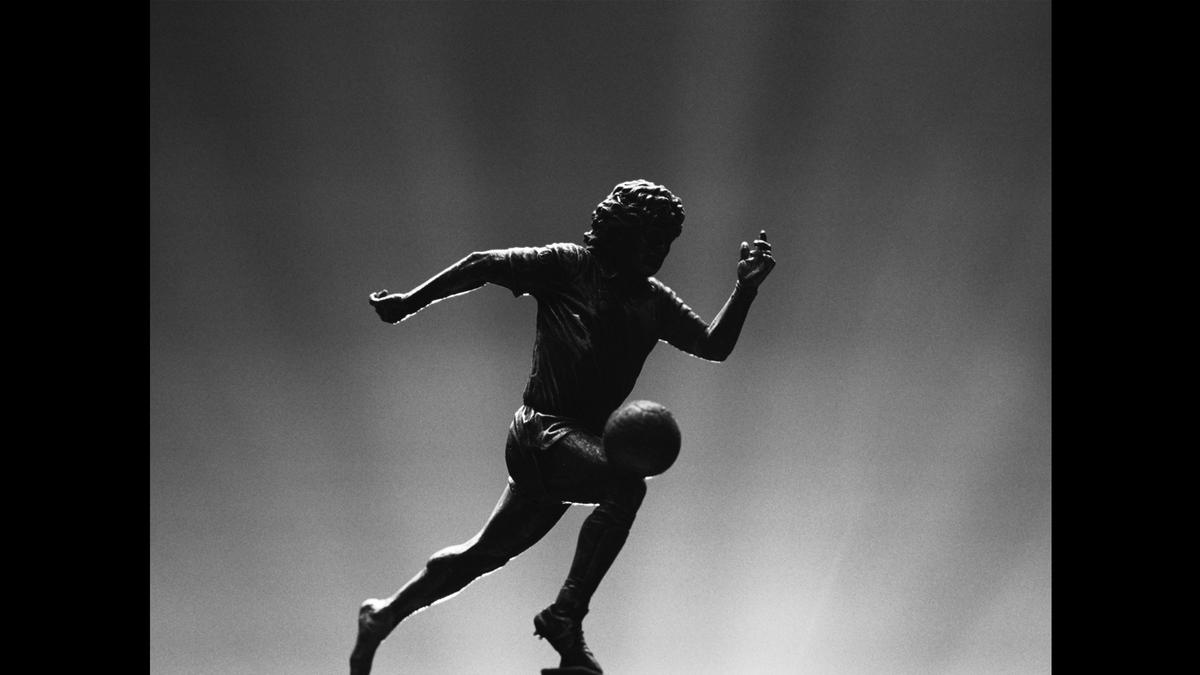
Argentine directors Juan Cabral and Santiago Franco’s The Match (El Partido) attempts a particularly complex feat. It condenses 220 years of history and geopolitics in a single 90-minute football clash between Argentina and England. Forty years on, that 1986 match is still regarded as one the greatest to be ever played.
The second football film, Cantona, made by David Tryhorn and Ben Nicholas, is a deep dive into the mind of the iconic but always controversial Éric Cantona, whose five years at Manchester United in the 1990s went into football folklore for eternity and made him the most gifted French footballer of his generation.
“You are in the story that you create, not in the reality of the world. It is like cinema,” footballer-turned-actor Cantona says on camera as he helps the British directing duo make sense of the perplexing upheavals and career- threatening outbursts that rocked the ‘fiery’ Frenchman. He careened through as many as eight clubs in a decade until Man United and [team manager] Alex Ferguson happened to him.
On the Croisette
Four years in the works, the Cantona documentary forays into the highs and lows of his explosive career, piecing together his action-packed story with the help of interviews with Ferguson, former footballers David Beckham and Guy Roux, and his parents.
This is Cantona’s third time in Cannes. He was here as an actor in 2009 with Ken Loach’s Competition title, Looking for Eric. Five years later, he had a role in Kristian Levring’s out-of-competition entry The Salvation, starring Mads Mikkelsen.
This year, besides the documentary on his life and career, Cantona the actor is in first-time director Avril Besson’s Les Matins Merveilleux, a film much like the documentary about him. It is playing as part of the festival’s Special Screenings section.
Eric Cantona disciplinary hearing, 1995. Cantona sits with Alex Ferguson, in a still from the documentary ‘Cantona’. | Photo Credit: Offside / David Davies / Special arrangement
David Tryhorn (left) and Eric Cantona attend the ‘Cantona’ photocall at the 79th annual Cannes Film Festival, France. | Photo Credit: Getty Images
Football on the red carpet
In 2009, Cantona walked the red carpet with Ken Loach’s Looking for Eric, starring the footballer as himself in a fictional story of a down- and-out middle-aged football-obsessed postman in Manchester who hallucinates about his sporting idol when he’s at his lowest. Cantona, who had already debuted as an actor in Shekhar Kapur’s Elizabeth (1998) after hanging up his boots, impersonated the ‘spirit’ of the cult figure that the down-and-out Mancunian invoked.
Football has since been a constant presence at Festival de Cannes. United Passions premiered in 2014. Funded by FIFA, the film about the founding of the game’s governing body, was panned as propaganda.
Over the years, Cannes has programmed several other football films, including Pelé Eterno/Pelé Forever (2005), a two-hour documentary promoted by the Brazilian legend himself; Maradona by Kusturica (2008), by Serbian director Emir Kusturica; and Diego Maradona (2019), a documentary by British-Indian filmmaker Asif Kapadia.
Story beyond sports
Neither of the two films is only about football and that is what sets them apart from other sports documentaries. At the presentation of The Match, Thierry Fremaux, general delegate, Cannes Film Festival, asserted as much. “This film is not only about football. It is about a whole lot else,” he said. The Match played as part of Cannes Premiere, a segment of the festival that includes the latest films of auteurs Volker Schlöndorff, Kiyoshi Kurosawa and Christophe Honoré.
“We set out to make a film that everybody, even those who know nothing about the match, say a woman from Iowa in the U.S., can love,” says Cabral. He and Franco have done just that. The Match is both brilliantly cinematic and consistently riveting.
A still from the documentary The Match (El Partido). | Photo Credit: Special arrangement
It zooms in on the 1986 Argentina-England FIFA World Cup quarter-finals at the Estadio Azteca, Mexico City — a rousing encounter that produced two of the most iconic goals in the annals of the sport, both scored by Diego Maradona around four minutes apart. The first was the much-debated “Hand of God” goal, the next a result of pure genius.
The match was played four years after the Falklands War and the needle in the stands was palpable. On the pitch, bad blood may have strictly been confined to the long footballing rivalry between the two nations but a military conflict still fresh in public memory made the contest more bruising than it otherwise would have been.
Documentary filmmakers Juan Cabral (right) and Santiago Franco. | Photo Credit: Special arrangement
“These 22 men out in the middle did not know that they were carrying the burden of history. The huge weight on their backs and shoulders was invisible,” says Cabral.
It is this “invisible” burden that The Match maps, with a lot of drama and emotion thrown in. It has several players — Jorge Valdano, Jorge Burruchaga, Ricardo Giusti, Julio Olarticoechea and Oscar Ruggeri from Argentina; Gary Lineker, Peter Shilton and John Barnes from England — sharing their thoughts and memories of what unfolded that memorable evening.
Four decades on
Franco, whose association with the film began when friend Cabral gifted him a book on the 1986 World Cup match on his birthday, says: “When we started to think about the approaching 40th anniversary of the match, we knew we had no time to waste. The making of the film was, therefore, extremely intense. It was non-stop work for a year and a half.”
Every step of the way, the film demanded complete absorption and focus. “When you make a documentary, it has to be as elegant as Maradona’s sublime second goal. You endure the pain of the process because there is something beautiful to be achieved at the end of it,” says Cabral.
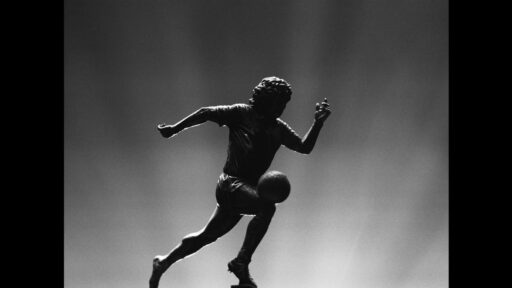
Maradona’s jersey from a still from the documentary The Match (El Partido). | Photo Credit: Special arrangement
Much of the beauty of the film stems from the lively narration provided by Lineker (in English) and Valdano (in Spanish). “Both are kind of philosophers,” says Cabral. “They are amazing storytellers. They have a way with words. Lineker is a superstar on TV while Valdano has written books on football. Getting them on board was a no-brainer.”
The documentary is 91 minutes long, exactly as long as the match it is about. The drama and insight that it delivers is far more than an hour and a half of the film’s runtime.
A still from the documentary The Match (El Partido). | Photo Credit: Special arrangement
Both Cabral and Franco say that The Match is an important film because it is about the sport and because it “exceeds football”.
Would the film have been any different had Maradona been alive? “Maradona is ever present in The Match,” says Franco. “For us, he isn’t gone. He is still very much around. Towards the end, there is a message — clear and transparent. There is no justice in football and there is no justice in life,” adds Cabral. “You either try to overcome the situation through humanity and humour or you go to war, which makes no sense at all.”
The writer is a New Delhi-based film critic.