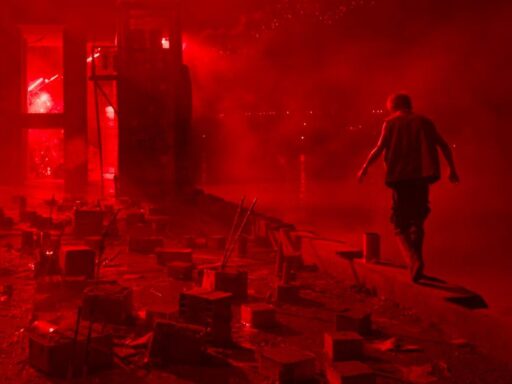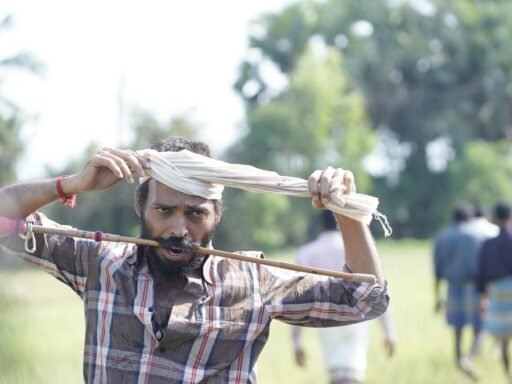

A still from ‘Khalid Ke Shivaji’ | Photo Credit: Rajshri Marathi/YouTube
The film remembers Shivaji as an ideal of syncretism in the fractured realities of today. It opens with a stirring sign of that co-existence as the jovial tune of a bhajan is blended with the elevating sound of the azaan. Later, a boy in school uniform, Khalid (Krish More), runs towards the Gram Panchayat gathering where the villagers are pointing out problems related to water and road to the Sarpanch, who tackles these concerns by laying out his plan to build a temple around. Even though dipped in familiarity, the scene authentically contextualises the skewed priorities of those in power.
Khalid observes the proceeding intently and is hooked later to his history teacher, Salve’s (a brilliant Kailash Waghmare) dramatic retelling of Shivaji’s thrilling meet with Mughal commander Afzal Khan. The lesson however, brings trouble for Khalid as his classmates call him Afzal Khan, making him to question his own identity and the relationship he shares with Shivaji.
Khalid Ke Shivaji (Marathi)
Director: Raj Pritam More
Cast: Krish More, Sushama Deshpande, Kailash Waghmare, Bharat Ganeshpure
Runtime: 112 minutes
Storyline: A muslim boy gets fascinated with the Marathi warrior Shivaji as his classmates tease him with the name of Mughal commander Afzal Khan, making him question the nature of his identity and faith
Initially slated to release in theatres last year, Khalid Ke Shivaji sparked an outrage over some facts about the Maratha warrior shown in its trailer, which resulted in halting its release. The film was directly dumped on OTT recently and not without a fair share of alterations that are easily noticeable in its dubbed dialogues on multiple occasions. Like one scene early on where Khalid complains to his teacher about being bullied constantly by his classmates as his lips point towards a dialogue asking the teacher whether he is being called Afzal Khan because of his Muslim identity. The dubbed portion removes this part entirely, keeping the conversation only about Khalid mentioning the bullying. It is a poignant scene for how More places a hoarding of the preamble of India’s constitution in the background. However, due to the change, its effect is softened. A lot of other scenes, where Khalid’s curiosity sparks discussions on religion and secularism, meet the same fate.
A still from ‘Khalid Ke Shivaji’ | Photo Credit: Rajshri Marathi/YouTube
His questions also lead to a host of wholesome moments, like the one where he forms an unlikely friendship with a Hindu monk or his interactions with his father outside the mosque, which become reflections on the nature of faith and humanity. Their effect, however, is fragmented due to the directness in dialogue and even how hurried Krish remains in his delivery. That’s why, even his conversations with a lion mask throughout the film doesn’t quite reach their desired potential.
More also makes some mundane observations that strike out in some scenes. Like how Khalid’s illiterate grandmother refers to a relative named Afzal when he tells her about Afzal Khan. Or in the classroom when his teacher scolds him for making a small mistake in the spelling of history, and Khalid asks, “Does a change in alphabet change the course of history?”, inviting a silent reaction from the teacher. Apart from these few exchanges, however, More merely remains satisfied with the uniqueness of the plot and stumbles to add a sense of progression in the screenplay. Although his representation of the marginalisation of a Muslim family remains compelling. His gaze is exploratory and sensitive, especially in how he imagines Khalid’s father as a compassionate man, imbuing him with dignity and self-respect.
What he loses out in the writing, More tries to make up in the visuals, which are shot with a comforting touch by cinematographer Vijay Mishra, keeping the film on track. One especially striking image features Khalid looking at Shivaji’s statue as its shadow falls right beside him due to the sudden bursts of lightning in the sky. The film needed more such sequences of awe and wonder to compliment the socio-political themes and bring the innocence of Khalid’s vision into the fold.
It’s the film’s empathetic handling that ultimately sticks everything together as the second half features Khalid preparing to embody Shivaji at a small play in school. His practise sessions offer a quick glimpse into the life of Shivaji and the ideals he stood for, as Khalid innocently performs in front of his friends and family, leading to an engrossing third act that ends ultimately on a mildly tragic note, making a strong case for how Shivaji’s followers comfortably remain masked in his outer appearance while forgetting his inner thoughts and vision.
The tragedy is also representative of the loss of plurality in today’s times where the child is tactfully made not to play Shivaji just due to his name and bigots from both the religions join hands to make sure that Khalid doesn’t get to stand on stage as Shivaji. In these moments, the film asks if the warrior king belongs only to one community. That’s when the sharpness in the title rings true: Shivaji belongs to Khalid as much as Khalid belongs to Shivaji. More strips the warrior king of his monumentality, even as he acknowledges the burden of his deification in a striking image of Shivaji’s statue sagging under the weight of garlands. Spectacles cannot capture him; decibels cannot remember him. Shivaji survives instead in the curiosity of a child, whose wondrous little fingers brush across his photograph in a history textbook.
Khalid Ke Shivaji is currently streaming on YouTube, BookMyShow and Apple TV
Published – July 07, 2026 01:01 pm IST