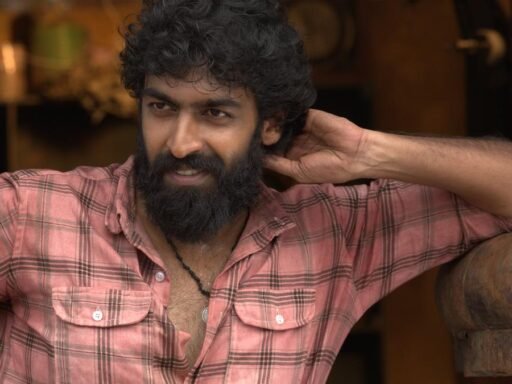



The rustic world is rendered with attention to detail, and the screenplay attempts to spring surprises at several turns. But the film falters at its core: the love story never quite makes the audience root wholeheartedly for its characters. The story had immense potential to build on love and pathos, which it does not fully achieve.
For those wondering whether the titular character’s name signals Communist leanings, the makers say it simply stems from the observation that people in villages are often named after well-known personalities.
Lenin (Telugu)
Director: Murali Kishor Abburu
Cast: Akhil Akkineni, Bhagyashri Borse
Runtime: 159 minutes
Storyline: Deceit often comes from close quarters and when the protagonist discovers this, the path ahead isn’t easy.
In the film, a young Lenin is portrayed as an outsider who enters the village during the festivities. Driven by the promise of a good meal, he does something unexpected that ushers in good tidings. The villagers consider it an auspicious sign, and Lenin is soon adored. His hunger — first for a hearty meal, then for love and friendship, and eventually revenge — drives his actions.
The opening portions draw liberally from the Mahabharata, foreshadowing how the lead character may have to wage war against those he once considered his own. When Lenin (Akhil Akkineni) sets out to settle scores, he is accompanied by his loyal canine, Kannaiyah. The events that gradually unravel his past, however, follow the familiar template of a mass-action drama.
It takes a while to shake off Akhil’s suave, urban image and grow accustomed to seeing him sport a duskier look and speak in the Chittoor dialect. The narrative introduces several characters with parallels to figures from the Mahabharata and Ramayana. The romance between Lenin and Bharathi (Bhagyashri Borse) blooms amid ominous portents. An episode involving a game of cards and a Shakuni-like character signals the dangers that lie ahead for the couple.
The origins of the love story could have been explored with greater depth instead of following a conventional meet-cute template. Rather than establishing a strong bond between the lead characters, the film offers an overdose of song and dance.
On the brighter side, Bharathi is presented as a woman capable of taking control, even if briefly. She refuses to remain a spectator during the game of cards and is unafraid to speak her mind. This assertiveness resurfaces in a crucial scene when she questions why a woman’s consent is not sought in marriage. It offers some respite at a time when star-led mainstream Telugu films continue to draw criticism for objectifying women. Yet Lenin, too, occasionally falls into this trap, particularly in its fixation on its leading woman’s midriff.
The other woman who plays a pivotal role in the drama is portrayed by Easwari Rao. It is a layered character, and despite limited screen time, she makes her presence count.
In its first hour, Lenin examines the vengefulness born of wounded pride — both in those who inflict harm and those who receive it — and the many ways it can wreck relationships. The initial portions require patience as the film establishes its milieu and works through familiar tropes. The latter half builds intrigue as the narrative begins to reveal its secrets.
Among the film’s many characters, some are reduced to cardboard villains, while others remain formidable and ominous. However, the numerous twists and the excess of mythological references make the proceedings tedious. Some revelations land effectively; others are easy to anticipate. When a devious woman suddenly retreats into silence, for instance, it becomes evident that something larger is at play.
Akhil, who inhabited urban characters with remarkable ease in his earlier films, makes an earnest attempt to embrace a rustic avatar and is convincing in both the romantic and action sequences. After Kaantha, Bhagyashri Borse gets another role that allows her to demonstrate her potential. She has a striking screen presence and fits the part of a woman caught at the crossroads of love and war. Among the supporting cast, Sivaji and Brahmaji make an impression, but it is the actor playing a covert antagonist who steals the thunder.
Leon Britto’s cinematography and S Thaman’s music do their part to elevate the drama. Ultimately, however, the blood-soaked saga grows tiresome in its reliance on the epics to do the heavy lifting.
An early dialogue stresses that the protagonist is not “a closed chapter”, as others perceive him to be. The line can also be read as a reference to Akhil’s career, which suffered a setback after his previous film, Agent, tanked at the box office. In Lenin, Akhil does display marked growth as an actor. But a fresher script — one that did not fall back on the mass-action template or echo Pushpa and other rural dramas — might have brought something new to the table.