

Though ostensibly focused on extraterrestrial life, first-contact stories have consistently explored humanity’s attempts to understand forces beyond familiar systems of knowledge. Across more than a century, extraterrestrials have played the roles of invaders, gods, refugees, mirrors, parasites, colonial powers, ecological warnings, and philosophical riddles. The shape of the alien has changed with each generation because the fears and aspirations projected onto it have evolved with time.
The earliest modern template came in 1898 when H.G. Wells published The War of the Worlds. Wells instinctively understood something many later imitators would spend decades rediscovering — the terror of contact emerged from powerlessness. His Martian invaders treated humanity with the same brutal apathy European empires had shown colonised peoples across Africa, Asia, and the Americas. The novel appeared during the height of British imperial expansion, yet its staying power came from forcing readers to imagine themselves on the receiving end of that violent conquest.
A still from Steven Speilberg’s 2005 adaptation, ‘War of the Worlds’ | Photo Credit: Paramount Pictures
Alien invasion cinema throughout the twentieth century inherited those anxieties, and the Cold War accelerated that trend. American sci-fi films of the 1950s turned extraterrestrials into vessels for political paranoia because the possibility of nuclear annihilation and ideological infiltration already influenced public consciousness. Don Siegel’s Invasion of the Body Snatchers imagined entire communities replaced by emotionless duplicates, reflecting fears surrounding communist infiltration during the McCarthy era. Even hopeful films carried atomic-age dread. Robert Wise’s original The Day the Earth Stood Still presented Klaatu as a benevolent visitor, yet his message centred on nuclear brinkmanship because the probabilty of self-destruction had become impossible to ignore.
A still from Don Siegel’s ‘Invasion of the Body Snatchers’ | Photo Credit: Walter Wanger Productions
By the late 1960s, first-contact cinema began asking different questions. Space exploration had expanded public imagination while Vietnam and Watergate weakened faith in institutions. Stanley Kubrick’s 2001: A Space Odyssey abandoned invasion entirely in favour of cosmic mystery. The alien presence remained largely unseen, manifesting through monoliths that accelerated evolution and nudged humanity toward an unknowable future.
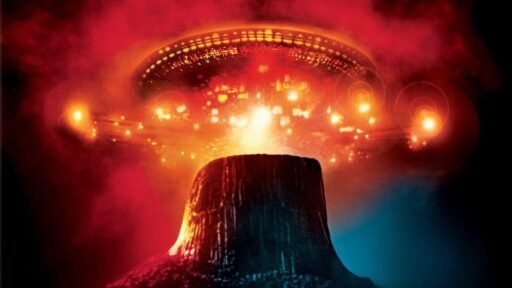
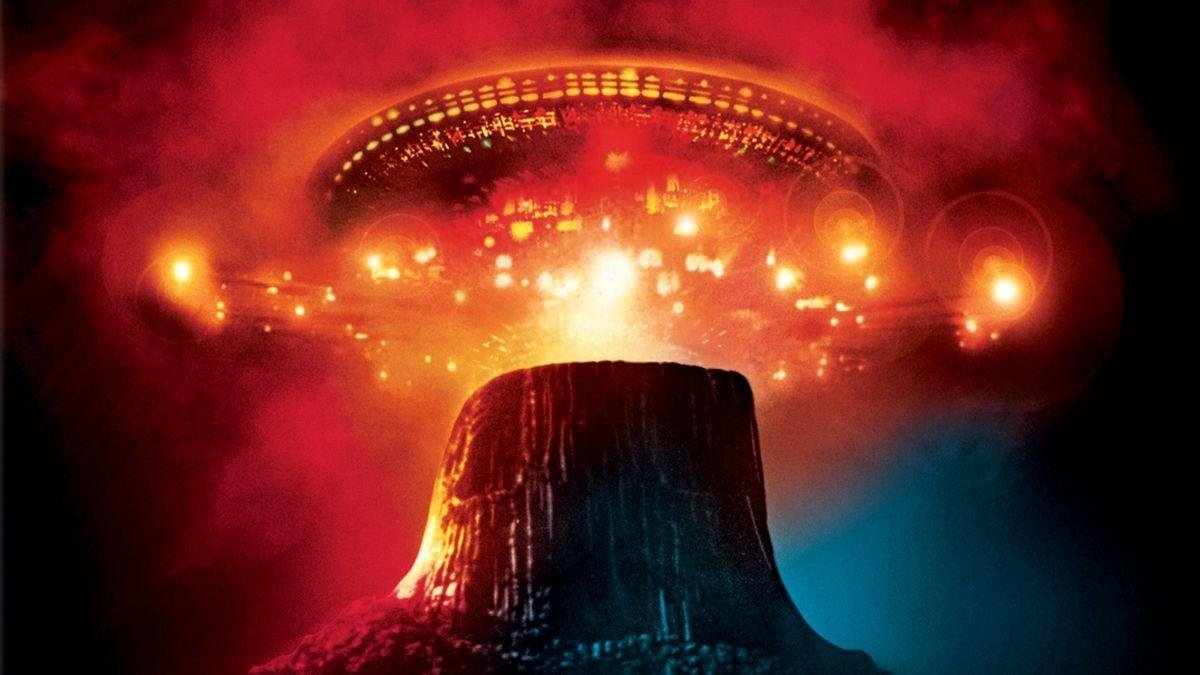
But few filmmakers embraced a sense of unbridled wonder with the unknown more completely than Spielberg. When Close Encounters of the Third Kind released in 1977, it effectively rewrote the very grammar of alien cinema. Richard Dreyfuss’ Roy Neary abandons his job, his family, and eventually his place in ordinary society because a brief glimpse of something impossible has broken his ability to care about anything else. When contact finally occurs at Devils Tower, Spielberg and composer John Williams turn the climax into a strangely moving duet between a synthesiser and a spacecraft with a simple five-note melody.
That idea reached its fullest expression through Carl Sagan’s Contact and Denis Villeneuve’s Arrival. Both recognised that contact begins with communication. Jodie Foster’s Ellie Arroway discovers a coded transmission from beyond and spends the film navigating politicians, engineers, and sceptics. Nearly two decades later, Arrival reduced first contact to language lessons inside a mist-filled spacecraft, where Amy Adams’ Louise Banks tests the Sapir-Whorf hypothesis against heptapod visitors whose language reshapes her perception. Project Hail Mary reached much the same conclusion this year, treating communication as the foundation of an unlikely interstellar friendship and punctuating that first exchange with a wink to John Williams’ iconic five-note Close Encounters motif.
A still from Denis Villeneuve’s ‘Arrival’ | Photo Credit: FilmNation Entertainment
First contact has also proven fertile ground for traditional UFO folklore and urban legends. M. Night Shyamalan’s Signs draws heavily from crop-circle paranoia, filtering a global invasion through the anxieties of a grieving Pennsylvania family. Andrew Patterson’s The Vast of Night recreates the world of 1950s switchboard operators and amateur radio enthusiasts in a small town. And Egor Abramenko’s Sputnik channels a different strain of extraterrestrial mythology, embedding its creature within the secrecy of the Soviet military apparatus and the long tradition of state cover-ups that has accompanied UFO culture on both sides of the Iron Curtain.
Contrary to the Independence Day school of thought, alien invasions do not always occur within comfortable driving distance of Washington, D.C. — the genre’s most fascinating variations often emerged beyond Hollywood. Andrei Tarkovsky’s Solaris depicted first contact as a confrontation with memory and grief, while Kiyoshi Kurosawa’s Before We Vanish imagined invasion through the theft of human concepts themselves. Neill Blomkamp’s District 9 even relocated extraterrestrials into Johannesburg and framed them through the legacy of apartheid. And though it falls outside cinema, any discussion of modern first-contact fiction would feel incomplete without Cixin Liu’s The Three-Body Problem, whose influential Dark Forest hypothesis argues that silence may be the universe’s dominant survival strategy.
A still from Andrei Tarkovsky’s ‘Solaris’ | Photo Credit: Mosfilm
This holistic evolution helps explain why first-contact stories keep finding new life — every era tends to imagine the alien through its own dominant preoccupations. For over a century, science fiction has repeatedly asked what happens when humanity encounters something radically unfamiliar. Though the answers have varied according to circumstance, technology, politics, and culture, the question still persists.
Which brings us back to Spielberg. Details surrounding Disclosure Day still remain guarded, but its premise appears to revolve around the public confirmation of extraterrestrial life and the social aftershocks that follow. If the film succeeds, it will serve as a record of an era increasingly convinced that the unknown may already be here, even if the search for intelligent life elsewhere has repeatedly yielded uncomfortable findings much closer to home. Perhaps the truth was never really out there after all.