

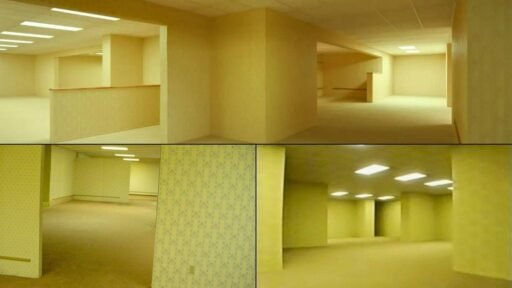
To understand the Backrooms, it helps to begin with another internet invention: the creepypasta. The word emerged during the 2000s from “copypasta”, a term for text copied and pasted across chatrooms and message boards. Users began circulating short horror stories through the same process, which gradually produced a library of digital campfire tales featuring creations such as Slender Man, the faceless figure invented on the Something Awful forums in 2009; Jeff the Killer, a grinning murderer whose distorted image became one of the internet’s most recognisable horror icons; BEN Drowned, a story about a haunted copy of The Legend of Zelda: Majora’s Mask; and Candle Cove, a fictional television programme that seemed to exist only in its viewers’ memories.
Unlike traditional horror fiction, creepypastas rarely belonged to a single author. Stories evolved through collective participation, with strangers adding details, rewriting lore, and expanding fictional universes across multiple platforms, and the Backrooms spawned through exactly that process.
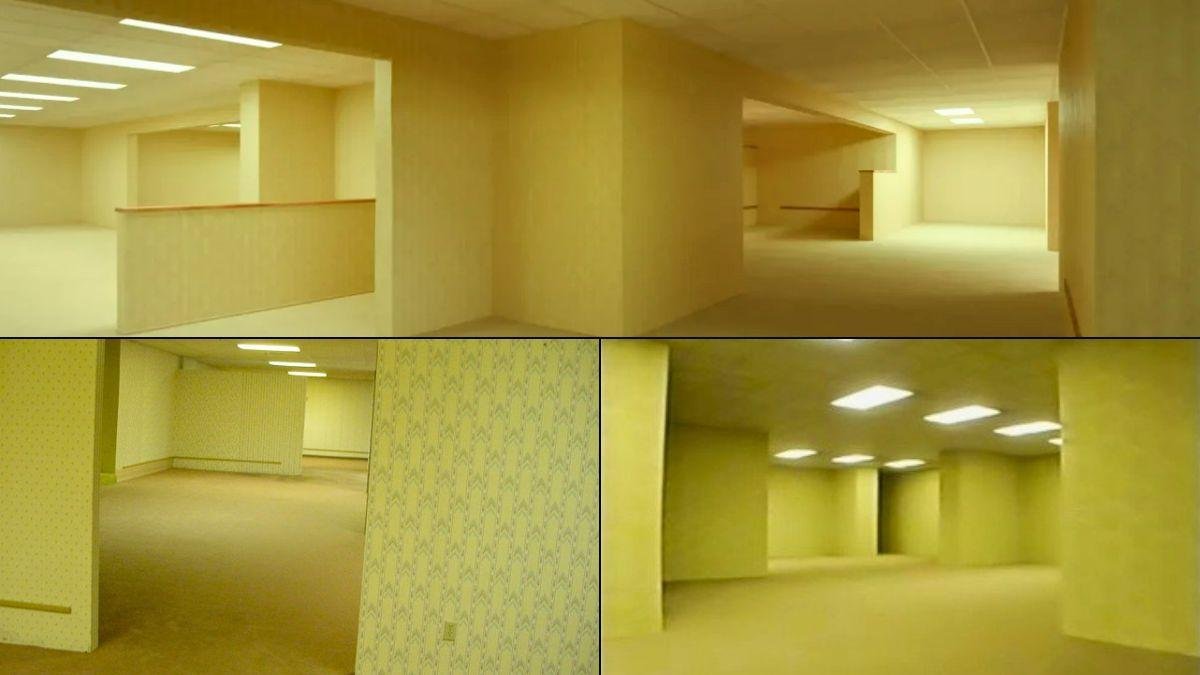
On May 12, 2019, an anonymous user on 4chan’s paranormal board (/x/), one of the internet’s most prolific incubators of urban legends, conspiracy theories, and collaborative horror stories, posted a photograph of an oddly unsettling interior space and invited others to share images that felt “off”.
Popular Internet meme known as “The Backrooms”. The photograph originates from a building located at 811 Oregon St., Oshkosh, Wisconsin, United States, and was taken before a renovation | Photo Credit: Wikimedia Commons
Another anonymous user responded with a paragraph describing a hidden dimension accessible by “noclipping” out of reality, borrowing a term from video games for passing through walls, because of a software glitch.
“If you’re not careful and you noclip out of reality in the wrong areas, you’ll end up in the Backrooms, where it’s nothing but the stink of old moist carpet, the madness of mono-yellow, the endless background noise of fluorescent lights at maximum hum-buzz, and approximately six hundred million square miles of randomly segmented empty rooms to be trapped in. God save you if you hear something wandering around nearby, because it sure as hell has heard you”Anonymous user4chan
The photograph itself became famous for capturing a particular kind of unease. Internet sleuths eventually traced the original image to a former HobbyTown USA store in Oshkosh, Wisconsin. It was photographed during renovation work in 2002 after a nearby office space had been knocked through to expand the shop’s floor area. By then, millions of people had already assigned their own meanings to it. The image showed pale yellow walls, industrial lighting, and empty floor space without any obvious purpose. Every element looked ordinary, but the combination just felt wrong.
That feeling belongs to a broader aesthetic category known as the liminal space. The word “liminal” comes from the Latin limen, meaning threshold. Anthropologists originally used the term to describe transitional stages between social states, and online culture repurposed it to describe physical locations caught between functions. These spaces generate unease because they appear designed for human activity while temporarily lacking human presence.
Several related concepts help explain why the Backrooms resonate so strongly. A Dead Mall refers to a once-busy shopping centre that has lost its tenants and visitors. French anthropologist Marc Augé coined the term “non-place” for locations such as airports, highways, and waiting rooms that people pass through without forming emotional attachments. Philosopher Michel Foucault described “heterotopias” as spaces that operate according to different social rules. And Kenopsia, a newer internet-coined term, describes the eerie atmosphere of a place usually filled with people that suddenly stands empty. The Backrooms combines elements from all these ideas into a single fictional landscape.
Kane Parsons’ representation of the Backrooms concept in his YouTube short ‘The Backrooms (Found Footage)’ | Photo Credit: YouTube/ Kane Pixels
As the Backrooms spread across Reddit, Discord servers, and fan-maintained wikis, the mythology rapidly expanded beyond the original yellow office floor. Users began organising the maze into numbered “levels”, each with its own geography, rules, and hazards. Some resembled abandoned industrial complexes, flooded hallways, hotels, and underground tunnels, while others drifted into increasingly surreal territory. The lore also introduced “entities”, a catch-all term for the creatures said to inhabit these spaces, ranging from vaguely described shadows to elaborate monster designs with detailed behavioural guides. By the early 2020s, the Backrooms had evolved into a vast collaborative universe with hundreds of levels, survival manuals, maps, and fictional research documents, transforming a single unsettling image into something closer to a crowd-sourced horror franchise.
Kane Parsons’ representation of an entity in the Backrooms, in his YouTube short ‘The Backrooms (Found Footage)’ | Photo Credit: YouTube/ Kane Pixels
But the mythology might still have remained a niche internet curiosity if Kane Parsons had not discovered it during high school. Working under the name Kane Pixels, the Californian teenager released The Backrooms (Found Footage) on YouTube in January 2022. Presented as recovered videotape from 1996, the short follows a cameraman who accidentally slips into the endless maze. Parsons used self-taught visual effects techniques, primarily working in Blender, to create impossible architecture that appeared disturbingly real. The first episode attracted tens of millions of views and eventually grew into a long-running series that accumulated more than 200 million views across YouTube. Hollywood quickly caught on, and soon, A24 announced a feature adaptation in 2023 with Parsons directing and horror producer James Wan attached to the project.
The Backrooms were also conceived at a moment when liminal imagery had already spread throughout popular culture. Players later identified traces of the aesthetic in The Stanley Parable, a 2013 indie videogame by Davey Wreden that traps players inside an eerily empty office building whose corridors seem to stretch beyond any logical purpose. Similar visual grammar appears in The Shining, Stanley Kubrick’s 1980 adaptation of Stephen King’s novel, where the vast hallways of the isolated Overlook Hotel generate unease through repetition and emptiness.
A still depicting the Overlook Hotel from Stanley Kubrick’s ‘The Shining’ | Photo Credit: Warner Bros.
The late David Lynch explored related territory in his masterwork Twin Peaks, the cult mystery drama that transformed small-town suburbia into uncanny psychological spaces. The 2022 Canadian horror film Skinamarink, directed by Kyle Edward Ball, built an entire feature around darkened domestic interiors that felt strangely detached from everyday life. Genki Kawamura’s recent Japanese film adaptation of Exit 8, a cult indie game about a commuter trapped in an endlessly looping subway passageway, translated another liminal-space phenomenon into feature-length horror.
A still depicting the Black Lodge from David Lynch’s ‘Twin Peaks’ | Photo Credit: Lynch/Frost Productions
And Severance, the Apple TV workplace thriller created by Dan Erickson, places its characters inside a maze-like corporate office whose endless white corridors have become one of modern television’s defining examples of liminal design, with Erickson even specifically citing the Backrooms as a visual influence on the series.
A still depicting Macrodata Refinement at Lumon in Dan Erickson’s ‘Severance’ | Photo Credit: Apple TV
The release of Backrooms closes an unusually direct loop between internet culture and Hollywood. Few internet stories have travelled from anonymity to multiplex with such a clear paper trail, which makes the Backrooms as much a story about the modern internet as it is a horror franchise.
Backrooms releases in Indian theatres this Friday