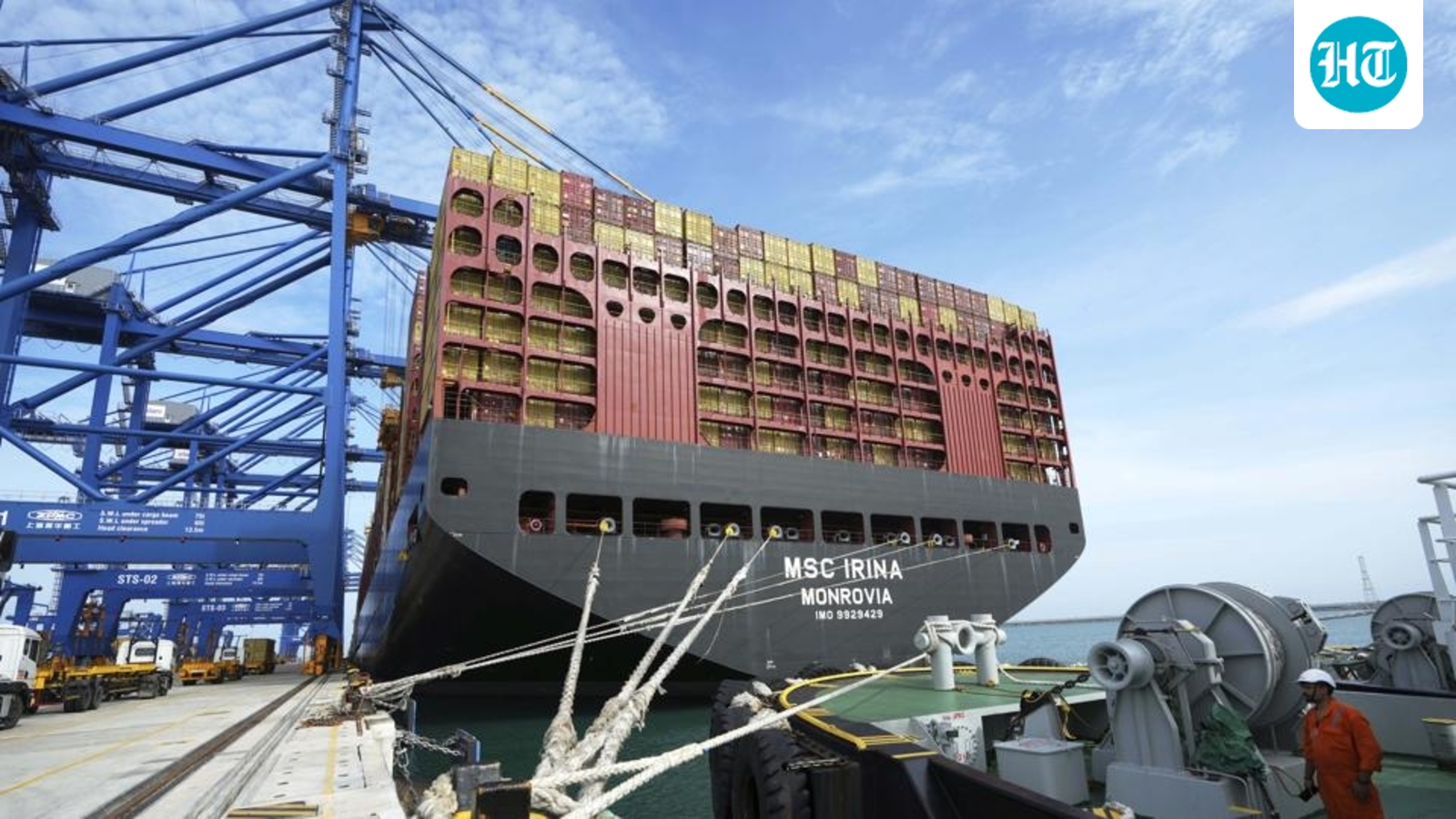

The Vizhinjam Port was formally inaugurated by PM Modi in Thiruvananthapuram in May last year and has an annual capacity of up to 5 million TEUs. (File Photo/AP)
Vizhinjam Port is India’s first deep-water container transhipment port in Kerala’s Thiruvananthapuram district, which was conceptualised in in 1991 and is now serving as a major transhipment hub for the world, with reportedly a hundred vessels lined up there.
Also read: ‘100 ships. One destination’: Shashi Tharoor’s big praise for Kerala’s Vizhinjam Port amid Strait of Hormuz crisis
All about Vizhinjam Port
Vizhinjam Port was built under the public private partnership mode at the cost of ₹8,900 crore. It is operated by the Adani Group and majority stake of it lies with the Kerala government.
According to its website, the port is designed primarily to cater container transhipment besides multi-purpose and break bulk cargo. A transhipment port is a facility where cargo containers are transferred from one ship to another before continuing to their final destination. These ports handle large volumes of international cargo.
The vision of the Vizhinjam Port is “to be the preferred international transshipment gateway on the Indian subcontinent known for operational excellence, industry leadership and sustainability enabled by a future-ready port ecosystem.”
Also read: India warns Iran of consequences after 2 tankers attacked in Strait of Hormuz: Officials
The mission is “to develop Vizhinjam Port as a pioneering deepwater transhipment hub leveraging cutting-edge infrastructure and technology to enable global trade, boost India’s blue economy and foster inclusive growth,” according to the port’s website.
The port was formally inaugurated by PM Modi in Thiruvananthapuram in May last year and has an annual capacity of up to 5 million TEUs.
According to Congress MP Shashi Tharoor, who touted it as India’s “transshipment answer to the world”, the port handled 61 vessels in last month alone, which is a “new record”. He also said that 100 berthing calls remain pending.
Tharoor said that the port handled its 1 millionth twenty-foot equivalent unit (TEU) in record time and is now fast-tracking Phase II.
Strategic location, natural advantage
The port is located some 10 nautical miles from the key and often busy international shipping route connecting Europe, the Persian Gulf and the Far East, making its location strategic trade-wise.
Also, the port as a deep draft of 18m close to its shore, which can allow it to host even ultra-large next-gen container ships requiring 20m+ drafts, the company says.
The port is also future proof with its capacity of 18,000+ TEU ships and its infrastructure that can be expanded to accommodate growing transshipping demand.